Athens’ archaeological sites tell different parts of the city’s story. The Acropolis is a place of temples and monumental architecture. The Ancient Agora brings public life into focus. Cemeteries, theatres and Roman-era buildings add other perspectives.
Begin with one major site, then choose an extra stop that interests you. You will get more from a manageable route with time to look, read and rest.
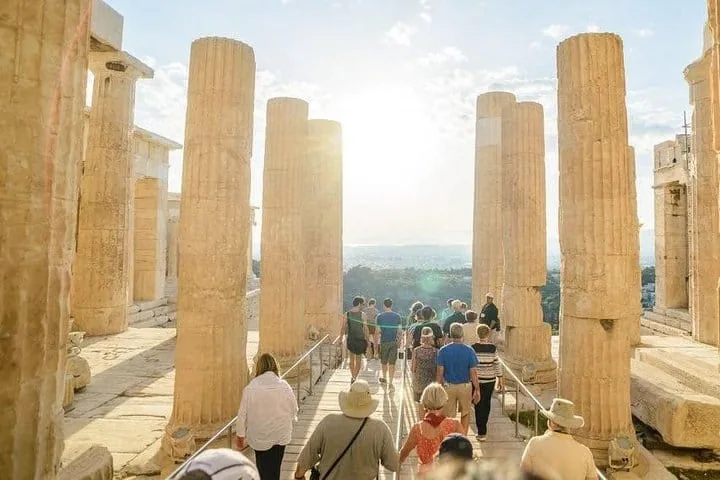
The Acropolis: temples above the city
The Parthenon, Erechtheion, Propylaia and Temple of Athena Nike form the principal monumental group on the Acropolis. The Parthenon was dedicated to Athena. Much of what makes the hill familiar today belongs to the major building programme of fifth-century BCE Athens. UNESCO’s account explains the significance of the ensemble.
Look for the relationship between buildings: the monumental entrance, the different temple forms and the way each sits on the rock. At the Erechtheion, the figures supporting the Caryatid porch are copies; five originals are in the Acropolis Museum.
Use the official Acropolis page for current tickets, visiting arrangements and access information. Follow the date and entry conditions on your ticket. Outdoor areas can be exposed, and paths include slopes and uneven surfaces; plan for the weather and ask the site about any access requirements.
The south slope: theatre and performance
The Theatre of Dionysus adds the story of performance to an Acropolis visit. It is on the south slope, while the Odeon of Herodes Atticus is a different monument. The pedestrian route around the hill lets you understand how these spaces relate to the city, even when access to individual monuments is restricted. The official city guide describes the Acropolis and Koukaki area.
Access to slope routes and seating areas can vary. A sightseeing ticket and a performance ticket serve different purposes.
The Ancient Agora: public life and a reconstructed stoa
The Ancient Agora was a focus of civic, commercial and political life, associated with figures including Socrates. The Temple of Hephaestus and the Stoa of Attalos are useful landmarks for orienting yourself among the remains.
The long Stoa of Attalos you see today was reconstructed in the 1950s to house the site museum and research facilities. Knowing this helps distinguish surviving ancient fabric from later reconstruction. The American School of Classical Studies, which conducts excavations here, explains the work and the evidence of everyday and civic life recovered from the site.
Official visitor notices matter here: conservation or construction work can change entrances and routes.
The Roman Agora and Tower of the Winds
The Roman Agora is a separate site from the Ancient Agora. Look for the surviving gateway and imagine the courtyard framed by commercial spaces.
At the Tower of the Winds, look up at the figures representing the winds. The octagonal building combined sundials with a water clock and a roof-mounted wind vane. The city’s official guide dates it to around 100–50 BCE.
Nearby, Hadrian’s Library adds a Roman-era complex associated with books, reading and lectures. Its surviving architecture is a useful reason to pause around Monastiraki rather than hurry straight through.
The Olympieion and Hadrian’s Arch
The scale of the Temple of Olympian Zeus is still striking in its surviving columns. Building began in the sixth century BCE and was completed under Emperor Hadrian in 131–132 CE. The official Olympieion guide places that long history in context and links to neighbouring Hadrian’s Gate, also called Hadrian’s Arch.
Combine this area with a central Athens walk, leaving time to appreciate the columns from the permitted visitor areas.
Kerameikos: memory, gates and funerary art
Kerameikos brings together an ancient cemetery, city gates and finds displayed in its museum. It offers a more personal way to think about ancient Athens: commemoration, burial and the people whose names survived on monuments.
Move between the open site and the museum when both are available, reading the labels that distinguish originals, copies and objects recovered from particular locations. Treat graves and funerary sculpture with the same care as any other cultural monument.
For philosophy: choose the Academy or the Lyceum deliberately
Plato’s Academy Park is in the Akadimia Platonos area, away from the compact Acropolis–Monastiraki circuit. The remains are modest; go for the historical context and park rather than an expectation of a standing classical academy.
Aristotle’s Lyceum is a different site near the Byzantine and Christian Museum. It preserves remains of the palaestra of the ancient gymnasium associated with Aristotle’s teaching. Plan these as separate destinations. They are not adjacent stops on one short walk.
A route that leaves time to look
- First visit: prioritise the Acropolis, then decide whether you have energy for its museum. Museum admission is separate.
- Civic and Roman Athens: choose the Ancient Agora, then one of the Roman Agora or Hadrian’s Library, with a meal between visits.
- A second history day: choose Kerameikos, the Olympieion or a philosophy-focused outing according to your interests.
Carry water, sun protection and a small bag; wear shoes suitable for uneven surfaces. Stay on permitted routes and leave stones, objects and structures untouched. Follow current photography and bag rules.
If you want a guide to put the sites in context, browse Athens cultural experiences and read the specific itinerary: archaeological-site admission, museum tickets and guiding are included only when your selected experience explicitly says so. For a different day outdoors, compare Saronic cruise routes. Any independent island sightseeing needs to fit the actual stop duration and return arrangements.
This guide was editorially reviewed on 1 November 2026. Check current venue, event and transport information before setting out.